Fascia and Muscle Tissue: Differences and Their Role in Movement
2026-02-15
The difference between fascia and muscle tissue: why working on the fascia may offer lasting change, while muscular massage often acts temporarily
An honest conversation about what is really happening in your body
Have you ever noticed that after a good massage you feel wonderful... but after a couple of weeks everything goes back to how it was? The shoulders are tense again, the neck stiff, and the back is under tension by the end of the working day. The problem is not that the massage was done badly. The point is that it works on the wrong tissue.
Most methods — massage, postural exercise, even yoga and Pilates — focus on the muscles. But there is something almost nobody talks about, despite the fact that it determines how you stand, how you walk and even how you perceive your body: the fascia.
According to recent research published in Frontiers in Physiology (2020), fascia is not a simple "wrapping", but an active tissue that transmits forces, influences the perception of bodily sensations and plays a key role in biomechanics. In this article we will examine what fascia and muscle tissue are, what their fundamental differences are, and why working on the fascia may be the key to more lasting structural change.
What is Fascia?
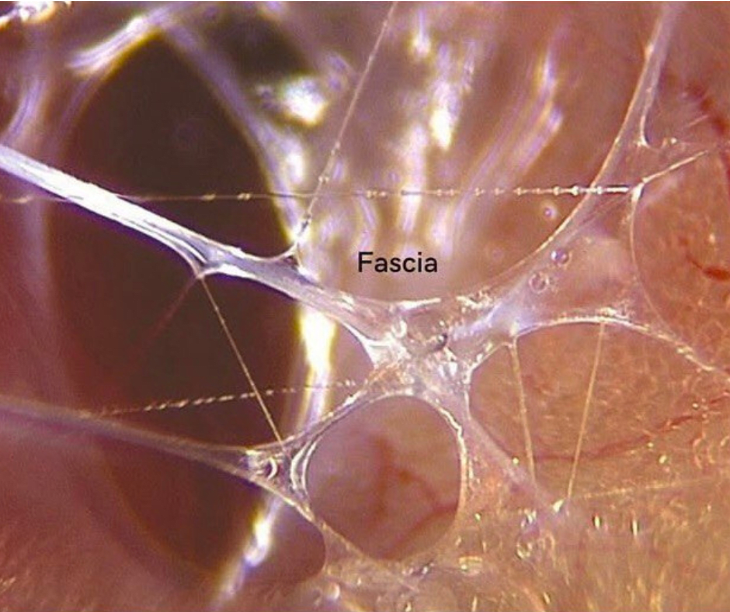
From a scientific perspective, fascia is a fibrous connective tissue that forms a continuous three-dimensional network throughout the body. It is composed primarily of collagen, elastin and fibroblasts — cells that produce the extracellular matrix.
Types of fascia:
Superficial fascia: located directly beneath the skin.
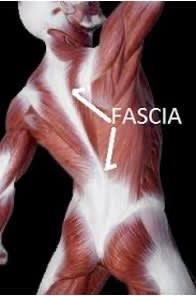
Deep fascia: surrounds muscles, bones and nerves.
Visceral fascia: protects the internal organs.
In your body, this "film" is a genuine intelligent system that:
Keeps everything in its place.
Transmits information about your position in space.
Important: it is often the source of recurring tension and discomfort signals.
This fascial network is elastic — capable of extending 10–20% without tearing — and is extremely sensitive to inflammatory states and accumulated tension.
This fascial network is elastic — capable of extending 10–20% without tearing — and is extremely sensitive to inflammatory states and accumulated tension.
What is muscle tissue?
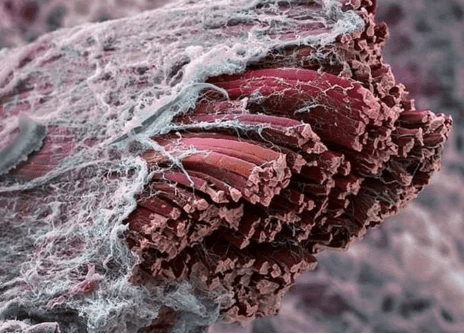
Muscle tissue is your body's "worker". It contracts and relaxes when you move. Its task is to generate movement. As research demonstrates, muscle tissue is always surrounded by fascia, but its structure is oriented towards contraction, not towards global connection.
Fascia is the primary source of information about the body's position in space (proprioception) and a potential source of discomfort signals (nociception). This is why working on it may produce more lasting changes over time.
Functions of fascia and muscle tissue in the body
Functions of fascia: much more than a simple wrapping
Force and tension transmission: Fascia distributes tension between muscles, bones and joints throughout the body via the myofascial meridians.
Proprioception: Helps the brain understand the body's position in space.
Structural support: Guarantees the integrity (tensegrity) of the entire system.
Influence on posture: Directly determines your stance and your balance.
Research indicates that fascia contains 6 to 10 times more sensory receptors than muscle, making it the body's richest sensory organ.
Functions of muscle tissue: the body's engines
Movement: Contraction for displacements and actions.
Metabolic support: Energy consumption to maintain tone.
Force generation: Localised and active movement of a specific segment or joint.
The interconnection: myofascial chains It is fundamental to understand that fascia and muscles work together through what are known as myofascial chains. This explains why tension in one area (for example, in the foot) may manifest as discomfort in a distant area (for example, in the neck).
Why do we experience tension and stiffness?
Here is what happens to your fascia when:
You sit for 8 hours in front of a computer.
You have had a physically intense experience (even a long time ago).
You move very little.
Conversely, you constantly overload the same areas.
The problem: adhesion and altered gliding
Fascia loses hydration and the layers begin to "stick" together (a phenomenon known as adhesion). Imagine that, instead of a slippery film, rigid adhesions have formed — like the pages of a book glued together.
What does all this lead to? Rigid fascia restricts the muscle, causing passive tension that the muscle is forced to work against. Your muscles begin to work against constant resistance. They pull, but the fascia holds them back. It is like running with an elastic band stretched between your legs: constant tension, persistent fatigue and, over time, increasingly recurring tension patterns. Furthermore, discomfort may manifest far from the source of the problem, since fascia is a unified network and not a collection of isolated parts.
What Structural Integration does and how it differs from massage
Massage works on the muscles: it relaxes, releases spasm. It is pleasant and useful, but it acts on the immediate signal, not on the deep structure. Structural Integration works on the structure: the fascial architecture of your body.
Structural Integration on the fascia
Rolfing, or Structural Integration, developed by Dr Ida Pauline Rolf, focuses on manual work with the fascia to explore bodily balance. This method uses a series of manual sessions to release fascial tension, exploring mobility and symmetry. In this approach, fascia is considered the organ of internal structure, capable of influencing not only physical balance, but also emotional balance.
How a session unfolds
I apply deep, slow and targeted manual pressure in order to:
Separate adhered fascial layers: restoring their capacity to glide over one another.
Restore hydration: to the fascial tissues and their visco-elastic properties.
Free the structure: when the fascia stops pulling the skeleton in non-optimal directions, the body can find its natural balance again.
The Result: why it works over the long term
When we work on the fascia, we are not simply "massaging" a tissue. We are exploring the structure, restoring the body's natural geometry and balance.
The result? Many clients report not only a sense of relief, but also a different way of supporting themselves — without effort, with greater efficiency and with less energy expenditure to maintain an upright position. It is like rebalancing the foundations of a house: everything else can settle into place. This is why many clients report that the changes following a Structural Integration series remain present over time.
The advantages of understanding the difference between fascia and muscles
Understanding this distinction may make it possible to:
Better understand recurring tension: knowing that it may be worth exploring the fascia, not only muscular spasm.
Optimise approaches to physical wellbeing: choosing a method that explores the deep structure.
Support the health of the fascial system: keeping the fascia hydrated and mobile over time.
Experience more lasting change: structural exploration rather than exclusively temporary relief.
For whom is Structural Integration intended?
This journey is for those who:
Are tired of temporary solutions and the "revolving door" of recurring tension.
Want to explore the deep structure of their body, not only attenuate surface signals.
Experience recurring tension that does not resolve with traditional massage.
Are ready for deep work with the body (it is not always a "relaxing spa experience").
Are seeking change that remains present over time.
Conclusion: fascia is the key to long-term wellbeing
The difference between fascia and muscle tissue lies in their nature: fascia connects, supports and perceives; muscles contract and move.
This distinction is useful for understanding why massage often offers a temporary effect (working on muscles), while Structural Integration may offer more lasting change (working on the fascial structure). Traditional methods have value for releasing local tension, but for exploring a deeper postural rebalancing and genuine movement efficiency, it may be worth working on the fascial system.
What is the next step?
If you recognise yourself in this description and are ready for deep work with your body, I invite you to an introductory conversation. We will carry out a fascial observation, identify areas of tension and define a specific journey together — because every body is unique and every fascial map tells a different story.
Are you ready to understand what is really happening in your body? Book a session: we will begin with an honest conversation and a thorough observation. Structural Integration offers a methodologically rigorous approach that works systematically on the fascial system. Many clients report changes that remain present over time.