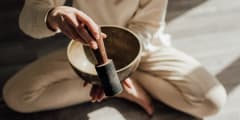
The craniosacral approach is hands-on work with a very light touch: the person lies down fully clothed, and the practitioner's hands listen to the micro-movements of the tissues between the skull and the sacrum. People choose it above all for stillness and deep relaxation. It is not a medical therapy and does not replace diagnosis or treatment.
What the craniosacral approach is
The name comes from the two ends on which attention is focused: the cranium and the sacrum, connected by the spine and by the membranes that surround the central nervous system. The method arose within osteopathy in the early twentieth century with William G. Sutherland and was developed and made widely known in the 1970s by the American osteopath John E. Upledger.
According to the craniosacral model, these tissues have a very subtle rhythmic movement that trained hands can feel and accompany. This is the model practitioners work with; it is not a description shared by the whole scientific community, as explained below.
How a session works
- Position: lying on the table, fully clothed, in comfortable clothes.
- Contact: the hands rest on the head, the back of the neck, the spine, the sacrum or the feet with minimal pressure, often compared to the weight of a coin.
- Pace: slow and silent. There are no manipulations, cracking or strong pressure.
- Duration: about one hour.
“I don't work on the client: I work with the client. The depth depends on the person, and the work never goes through pain.” — Tatsiana Harelava
What people notice
Most often people report deep relaxation, warmth, a feeling of lightness or “space”, sometimes drowsiness. Others notice little or nothing, especially the first time. What is felt is individual and cannot be guaranteed.
What research says
It is right to say this clearly: the scientific evidence for the craniosacral approach is limited. The available studies are few, often small and of variable quality, and the existence of a measurable “craniosacral rhythm” is debated. For this reason Tatsiana Harelava offers craniosacral sessions as a practice of relaxation and body awareness, not as a treatment for illnesses or symptoms.
What can be said with reasonable confidence is simpler: slow, light, attentive touch in a quiet setting is, for many people, an experience of deep relaxation. The rest belongs to personal observation, not to scientific proof.
When to choose it and when not to
It can be a good choice if you are going through a stressful period, if you prefer gentle contact, or if you are looking for an hour of silence for the body. It is not the right choice if you expect it to solve a medical problem: for persistent pain, sleep problems, anxiety or any symptom, your doctor remains the reference. Please let me know in advance if you are pregnant, have a medical condition, have recently had an injury or surgery, or are taking any medication: in some cases you will need to check with your doctor before the session.
Where to try it in Bolzano
Sessions take place in Bolzano, Piazza delle Erbe 37. Duration, how the session works and booking are on the page Craniosacral approach in Bolzano; for a free introductory conversation, write on WhatsApp.
Updated on